How to Propagate Hydrangea (Easy Step-by-Step Guide for Beginners)
Learn how to propagate hydrangea the easy way using cuttings. This beginner-friendly step-by-step guide shows how to grow new hydrangeas fast using water or soil.
If you’ve ever wished you could turn one hydrangea into ten… You can.
Propagating hydrangeas is one of the easiest ways to grow more of your favorite plants without spending money. And the best part? You don’t need anything fancy—just a healthy stem, a little patience, and the right method.
Once you learn how to do it, you’ll never look at your hydrangeas the same way again. Every branch becomes an opportunity for a brand-new plant.
In this guide, I’ll walk you through exactly how to propagate hydrangeas step by step—plus the simple tricks that make the difference between success and failure.
What Does It Mean to Propagate Hydrangea?
Propagation simply means growing a new plant from an existing one.
Instead of starting from seed, you take a cutting from a healthy hydrangea plant and encourage it to grow roots. Once roots form, that cutting becomes a brand new plant.
This works especially well with hydrangeas because they root easily from cuttings, particularly during the growing season.
Looking for more gardening tutorials?
10 Plants You Can Easily Grow from Cuttings
12 Tips for Planting a Cut Flower Garden
The Best Hummingbird Plants for Your Garden
When to Start Planting? Spring Gardening Timelines by Zone
When Is the Best Time to Propagate Hydrangeas?
Timing makes a big difference.
The best time to propagate hydrangeas is:
Late spring
Early summer
This is when the plant is producing softwood growth, which roots quickly and successfully.
You can also propagate later in the season, but it may take longer and be less reliable.
👉 Pro tip: Always take cuttings in the morning when the plant is well-hydrated.

How to Propagate Hydrangea (Easy Step-by-Step Guide for Beginners)
What You’ll Need
Before you start, gather your supplies:
- Sharp scissors or pruning shears
- A healthy hydrangea plant
- Small pots or containers
- Potting soil (or water for water method)
- Rooting hormone (optional, but helpful)
- Plastic bag or cover (to hold humidity)
Rooting hormone isn’t required, but it can help speed up root growth and improve success rates.
Step-by-Step: How to Propagate Hydrangea in Soil
This is the most reliable method and the one I recommend.

Start with a healthy plant that is free from disease and insects. Take the cuttings in the early morning- this is when plants are the most hydrated. A hydrated cutting will be much more successful than a dehydrated one.
The best stem to choose is one from this year’s growth (new growth). It will be lighter in color than the older stems. The best stem to choose is non-flowering with a lot of leaves.
Using your shears, cut the stem into 4- to 6-inch lengths. Cut each piece right above the node where leaves attach to the stem. These leaf nodes are where new roots will form.
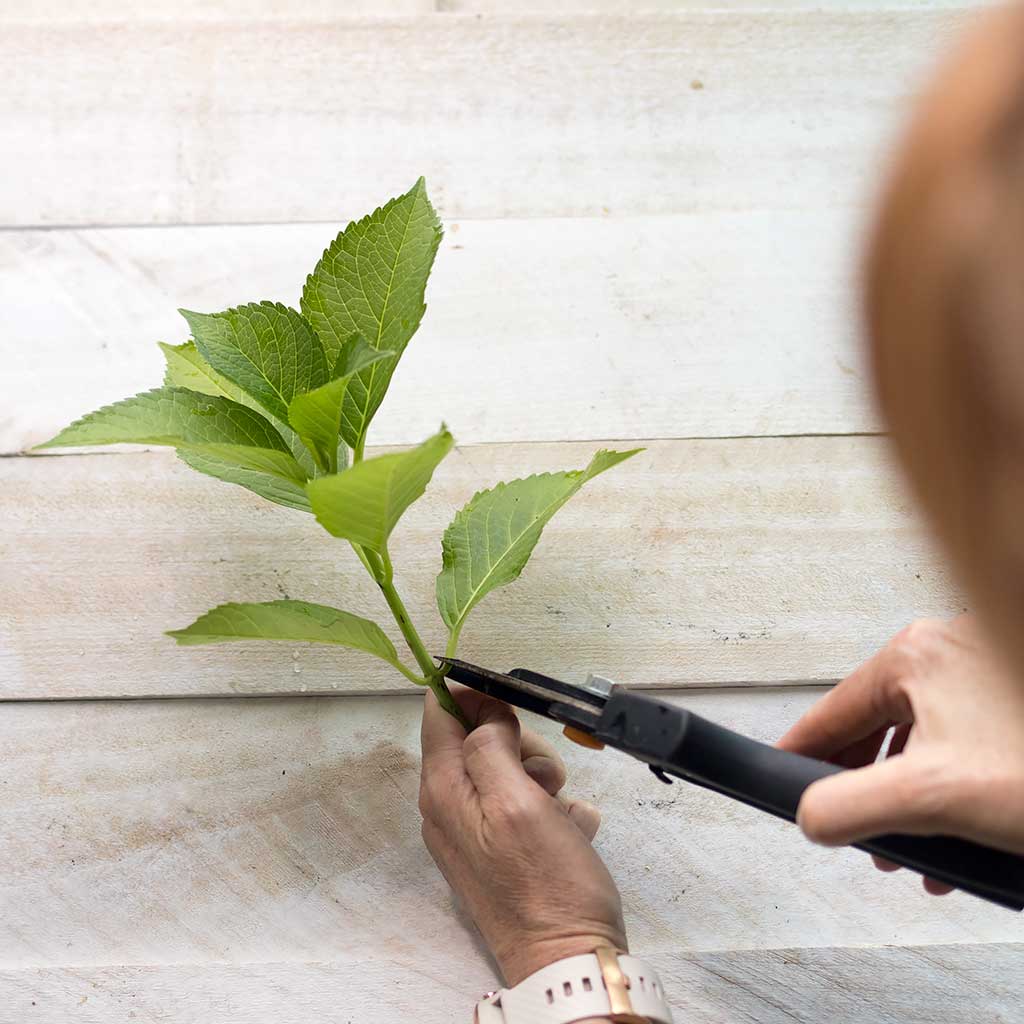
Remove all the lower leaves except the top set of leaves.

Trim down the leaves at the top. The leaves can be very taxing on a hydrangea stem that doesn’t have roots yet (there’s no system to get water to the leaves), so trimming the remaining leaves allows the plant to use its energy on root growth.

Dip the end of the cutting into the rooting hormone. A rooting hormone will stimulate root development on hydrangea cuttings. Growing medium also encourages uniform root growth, which improves your success rate. Gently tap the stem to remove excess hormone.

Use ta pencil to make planting holes in your prepared potting mix. Make holes at least 2 to 3 inches deep. The holes must be big enough to insert a cutting without dislodging the rooting powder. Insert the cutting so the potting mix covers the stem’s bottom half and at least two bare nodes. Then gently firm the potting mix around the cutting.
You can cover the pot with a plastic bag to create a mini greenhouse. Keep the hydrangea plant in indirect light (avoid direct sunlight) and make sure they are hydrated. You can also mist them to add moisture and humidity.
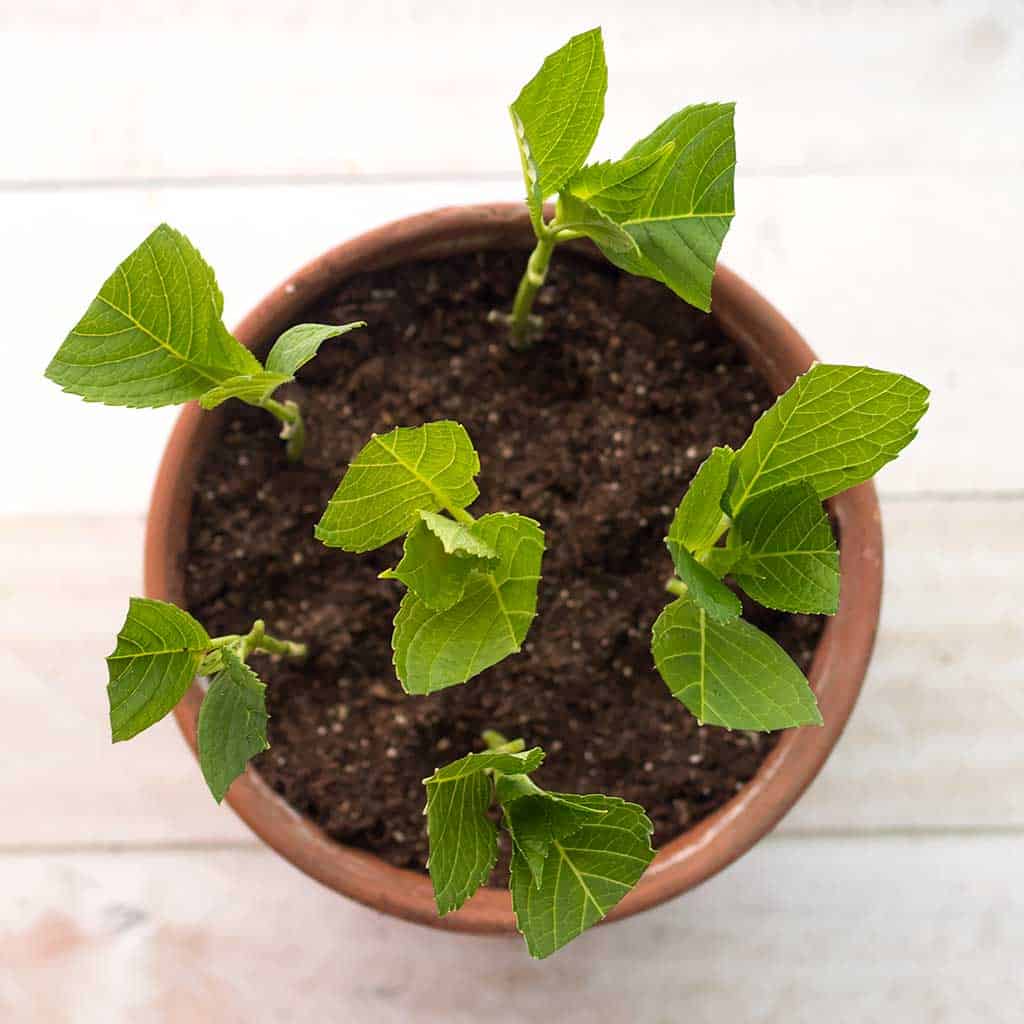
The cuttings should root in 2-3 weeks. You can gently tug on the cutting to feel if there’s resistance. If there is, this means that the roots have formed. Once the roots have formed, transplant the new plants to larger pots.
My Favorite DIY Planters:
Easy Raised Vegetable Garden with Pea Gravel
$20 Outdoor Planter DIY
DIY Privacy Screen Planter
Easy DIY Retaining Wall Planter
How to Propagate Hydrangea in Water
This method is popular because you can actually watch the roots grow.
Steps:
- Take a cutting just like above
- Remove lower leaves
- Place the stem in a glass of water (no leaves in water)
- Change the water every few days
- Keep in bright, indirect light
Roots typically appear in about 2 weeks.
Once roots are 1–2 inches long, transfer the cutting to soil.
👉 Note: Water propagation works, but soil-grown roots are usually stronger long-term.
👉 Note: Water propagation works, but soil-grown roots are usually stronger long-term.

Why Your Hydrangea Cuttings Aren’t Rooting
If your cuttings aren’t working, it’s usually one of these:
Too much sun
Cuttings need bright, indirect light—not full sun. Direct sunlight can dry them out quickly and cause the leaves to wilt before roots have a chance to form.
Overwatering
While moisture is important, soggy soil can lead to root rot. The soil should feel lightly damp, not wet. Good drainage is key to keeping cuttings healthy.
Wrong stem type
Older, woody stems are much harder to root. For best results, use soft, green growth from the current season, which is more flexible and roots faster.
Too many leaves
Leaving too many leaves on the cutting can cause it to lose moisture too quickly. Trim down to just a few leaves at the top so the plant can focus on developing roots.
Not enough humidity
Hydrangea cuttings thrive in a slightly humid environment. Without enough humidity, they can dry out before roots form. Covering the cutting loosely with a plastic bag or dome can help retain moisture and improve success rates.
Extra Tips for Success
These small tweaks can make a huge difference:
Take cuttings from non-flowering stems
Keep soil moist, not wet
Use clean tools to prevent disease
Place cuttings in bright shade
Be patient—some varieties root slower than others
Can You Propagate Hydrangeas Without Cutting?
Yes! Another easy method is layering.
This involves bending a branch down to the soil and covering part of it so it develops roots while still attached to the parent plant. Once rooted, you can separate it into a new plant.
This method is slower but very reliable.
How Long Does It Take to Grow a New Hydrangea?
Roots form: 2–3 weeks
Strong plant: 4–8 weeks
Ready for the garden: a few months
With proper care, your new hydrangea can start growing quickly and even bloom within a season or two.

FAQ: Propagating Hydrangeas
Can you propagate hydrangeas from cuttings?
Yes, hydrangeas are most commonly propagated from stem cuttings. This is the easiest and most reliable method, especially when using softwood cuttings taken in late spring or early summer. With the right conditions, most cuttings will root successfully and grow into full plants.
Is it better to propagate hydrangeas in water or soil?
Both methods work, but soil propagation is generally more reliable. Water propagation is great for beginners because you can see root development, but roots formed in soil tend to be stronger and adapt better when transplanted.
How long does it take for hydrangea cuttings to root?
Most hydrangea cuttings begin forming roots within 2 to 3 weeks. However, it may take a few more weeks before the roots are strong enough for transplanting.
Do you need rooting hormone for hydrangeas?
Rooting hormone is optional but helpful. It can speed up root development and increase success rates, especially for beginners or more stubborn varieties.
Can you grow hydrangeas from hardwood cuttings?
Yes, but it’s more difficult. Hardwood cuttings taken in fall or winter take longer to root and are less reliable than softwood cuttings.
Why are my hydrangea cuttings wilting?
Wilting is usually caused by lack of moisture or too much sun. Keep cuttings in a humid environment with indirect light and consistent moisture to prevent stress.
Propagating hydrangeas is one of the easiest and most rewarding garden projects you can try.
Once you do it once, it becomes second nature—and suddenly, one plant turns into many.
It’s simple, budget-friendly, and honestly… kind of addictive.
Looking for more gardening tutorials and tips?
DIY Raised Garden Bed Cover
How to Propogate Succulents the Easy Way
How to Protect Strawberry Plants from Birds
I love seeing your finished projects! If you enjoyed making this post, Easy Way to Successfully Propagate Hydrangea, or any of my other gardening tutorials, I’d love to see yours on Instagram, just tag me @ginamicheleny. Happy gardening!